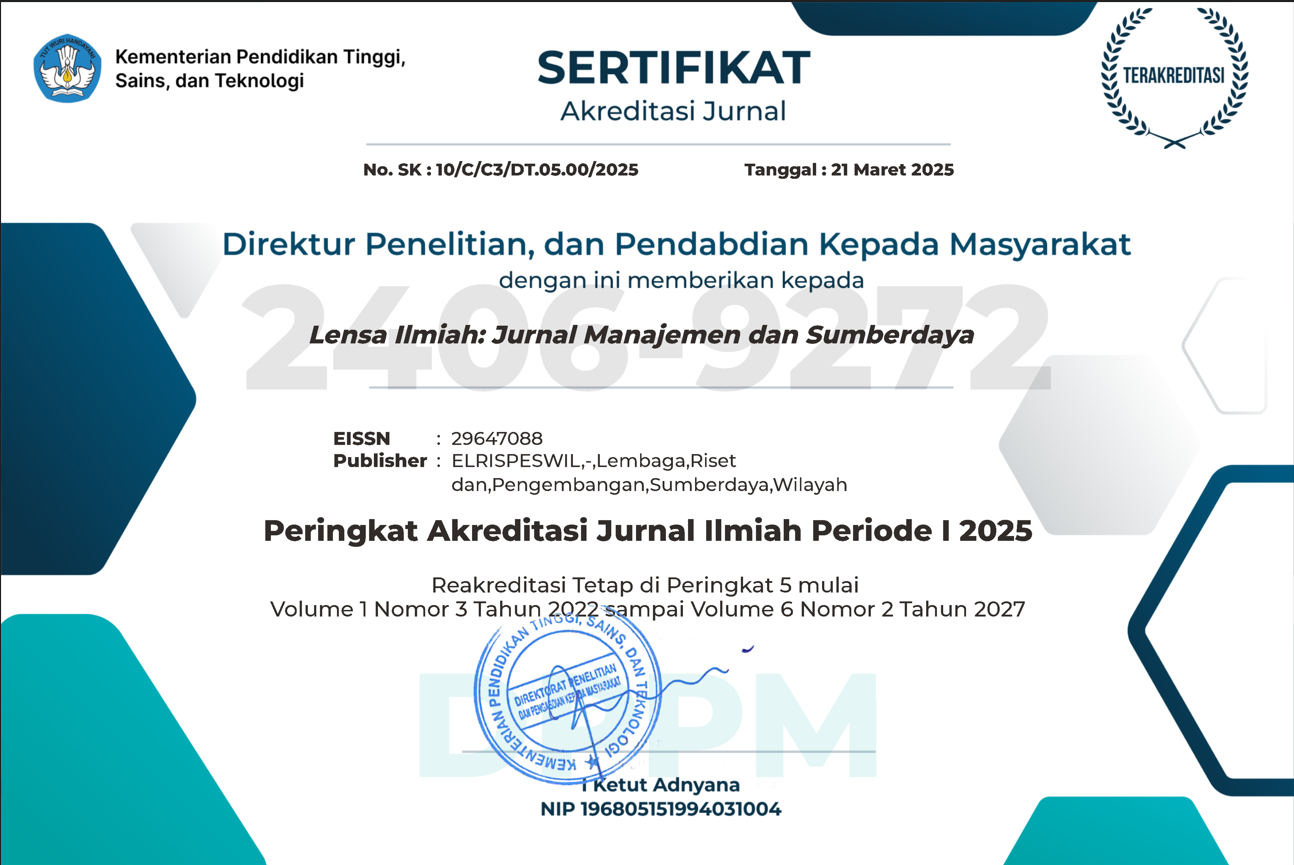
Sertifikat Akreditasi 2025-2027

Lensa Ilmiah: Jurnal Manajemen dan Sumberdaya (Scientific Lens: Journal of Management and Resources) is a peer-reviewed scientific journal published by ELRISPESWIL – Regional Resources Research and Development Institute three times a year. The journal provides an academic platform for researchers, academics, practitioners, policymakers, and professionals to disseminate original and scholarly works addressing contemporary issues in management, economics, business, accounting, entrepreneurship, development innovation, and human resources.
Scientific Lens aims to advance theoretical, empirical, and practical knowledge concerning how organizations, businesses, institutions, and resources are managed, developed, evaluated, and optimized to improve organizational performance, economic value, competitiveness, innovation, and sustainable development.
The journal particularly welcomes studies that demonstrate a clear research problem, appropriate theoretical or conceptual grounding, methodological rigor, and meaningful contribution to knowledge or practice. Manuscripts are expected to move beyond descriptive reporting by providing analytical, empirical, theoretical, or evidence-based insights relevant to management and resource development. The journal covers, but is not limited to, the following areas:
Research addressing theories, practices, processes, and contemporary developments in management, including strategic management, organizational management, leadership, organizational behavior, governance, decision-making, change management, knowledge management, and other areas concerned with organizational effectiveness and sustainability.
Theoretical and empirical studies addressing economic phenomena relevant to individuals, organizations, businesses, industries, and regional development, including microeconomics, macroeconomics, development economics, regional economics, public economics, behavioral economics, digital economy, creative economy, and other contemporary economic issues.
Economic studies should demonstrate a clear analytical contribution and relevance to management, business, resources, organizations, or development.
Research examining the planning, implementation, measurement, evaluation, and improvement of organizational operations and performance.
This area includes operations management, productivity, supply chain management, logistics, quality management, performance measurement, organizational efficiency, service operations, process improvement, and the development or application of organizational performance systems.
Research concerning the identification, assessment, management, mitigation, and governance of risks affecting organizations and businesses.
Relevant areas include enterprise risk management, financial risk, operational risk, strategic risk, market risk, business continuity, internal control, risk governance, crisis management, and organizational resilience.
Research addressing theoretical, empirical, and applied issues in accounting, including financial accounting, management accounting, public-sector accounting, auditing, taxation, accounting information systems, corporate reporting, sustainability accounting, accountability, financial disclosure, and developments in accounting practices.
The journal welcomes studies examining how accounting information and practices contribute to accountability, organizational decision-making, governance, and performance.
Research examining contemporary issues in business and marketing, including business strategy, consumer behavior, marketing management, digital marketing, service marketing, branding, customer relationship management, business models, e-commerce, market orientation, business competitiveness, and digital business transformation.
Studies should provide meaningful theoretical, empirical, or practical contributions to understanding markets, consumers, organizations, or business development.
Research addressing entrepreneurial processes, behaviors, ecosystems, and development, including entrepreneurship education within a business-development context, entrepreneurial intention and behavior, small and medium enterprises (SMEs), start-ups, social entrepreneurship, digital entrepreneurship, creative entrepreneurship, women entrepreneurship, family business, entrepreneurial ecosystems, and business innovation.
The journal particularly encourages studies examining entrepreneurship as a mechanism for economic development, innovation, employment creation, and resource optimization.
Research examining innovation in organizational, business, economic, institutional, community, and regional development that has a clear relationship with management and resource development.
This area includes social innovation, organizational innovation, business innovation, public-sector innovation, digital transformation, local economic development, community-based economic development, institutional development, and innovative approaches to resource utilization and regional development.
Manuscripts submitted under this scope must demonstrate a clear scientific contribution and direct relevance to management, economics, business, organizational development, human resources, or resource development. The mere application of a new technology, program, or activity does not by itself constitute development innovation.
Research addressing the management, development, behavior, performance, and sustainability of human resources within organizations and institutions.
Relevant topics include human resource management, human resource development, employee performance, competency development, recruitment and selection, training and development, career management, compensation, employee engagement, organizational commitment, job satisfaction, workplace well-being, talent management, leadership, organizational culture, and the future of work.
The journal also welcomes research examining the effects of digital transformation, artificial intelligence, automation, and emerging technologies on human resources and organizational practices, provided that the study demonstrates a clear management or organizational contribution.
Scientific Lens welcomes high-quality manuscripts employing quantitative, qualitative, mixed-methods, case studies, comparative studies, research and development, systematic literature reviews, meta-analyses, bibliometric studies, and other rigorous research approaches relevant to the journal's aims and scope.
Conceptual and theoretical manuscripts may also be considered when they provide a substantial contribution to the advancement of theories, frameworks, policies, or practices within the journal's fields.
Review manuscripts should employ a systematic, transparent, and reproducible method of literature identification, selection, analysis, and synthesis. Purely descriptive literature summaries without an explicit review methodology and scholarly contribution may not be considered.
To maintain a clear scholarly identity, Scientific Lens: Journal of Management and Resources generally does not consider manuscripts that:
Studies conducted within schools, universities, hospitals, government institutions, villages, companies, or other organizations are not automatically considered within scope based solely on the research setting. The central research problem, theoretical framework, variables or phenomena investigated, analysis, and contribution must substantively relate to the journal's scholarly domains.
For editorial screening purposes, a manuscript is considered within the scope of Scientific Lens when its primary research question and scholarly contribution clearly address one or more of the following:
management and organizations; economics and development; operations and performance; business risk; accounting and accountability; business and marketing; entrepreneurship; development innovation; or human resource management and development.
Accordingly, the journal prioritizes manuscripts that contribute to understanding how organizations and resources are managed, how economic and business value is created, how organizational performance is improved, how innovation supports development, and how human resources are developed and sustained in contemporary organizational and socioeconomic environments.
Sertifikat Akreditasi 2025-2027
Template & Submissions:


Supported:


Lensa Ilmiah: Jurnal Manajemen dan Sumberdaya (Journal: Scientific Lens: Journal of Management and Resources)
ELRISPESWIL - Lembaga Riset dan Pengembangan Sumberdaya Wilayah- (ELRISPESWIL - Regional Resources Research and Development Institute)
 This work is licensed under a Creative Commons Attribution-ShareAlike 4.0 International License.
 The journal provides immediate open access to all articles on the principle that making research freely available to the public; supports a greater global exchange of knowledge; and is an invaluable way to maximize research's visibility and impact, especially in the education field.

 JOURNAL & SUBMISSION
  Manuscript Submission
 Author Guidelines
  Aims and Scope
 Peer-Review Process
 Publication Frequency
 Publication Fee
 Editorial Board
 Reviewer List
 Abstract and Indexing
 Publication Ethics
  Plagiarism Policy
  Copyright and License
  Open Access statement
 Archiving Policy