Publication Ethics
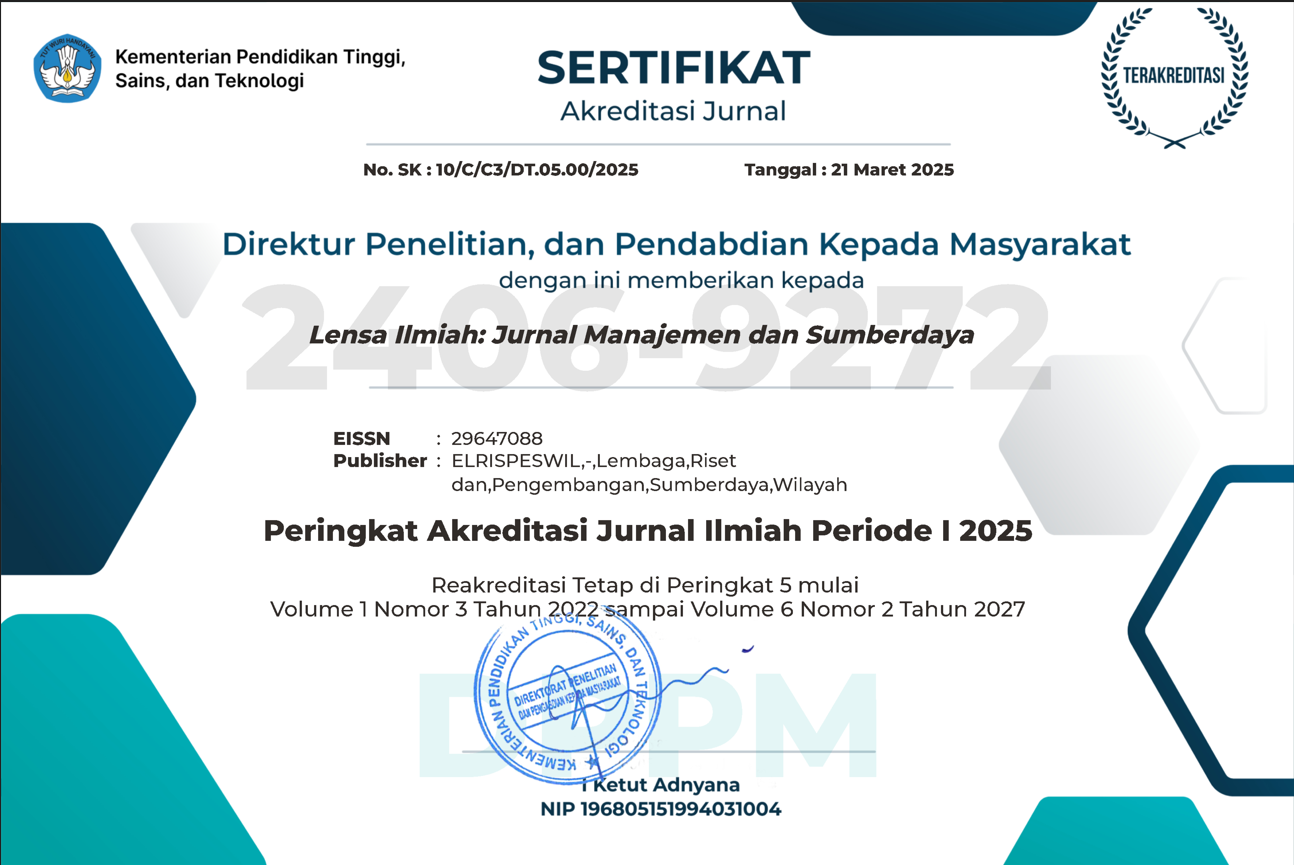
Lensa Ilmiah: Jurnal Manajemen dan Sumberdaya
1. Publication Ethics Statement
Lensa Ilmiah: Jurnal Manajemen dan Sumberdaya is a peer-reviewed scholarly journal committed to maintaining high standards of integrity, transparency, accountability, fairness, and ethical conduct throughout the publication process. This Publication Ethics policy establishes the ethical principles and responsibilities of all parties involved in scholarly publishing, including authors, editors, reviewers, and the publisher.
All parties are expected to uphold the integrity of the scholarly record and to conduct the publication process in accordance with recognized principles of publication ethics. The journal refers to the principles and good practices promoted by the Committee on Publication Ethics (COPE) and other relevant standards of scholarly publishing and research integrity.
2. Duties and Responsibilities of Authors
2.1 Reporting Standards
Authors of original research must present an accurate account of the work performed and provide an objective discussion of its significance. Research data and results must be reported honestly and accurately. Fabrication, falsification, inappropriate manipulation of data, misleading presentation of findings, or knowingly inaccurate statements constitute unethical behavior and are unacceptable.
A manuscript should contain sufficient information, methodological detail, and appropriate references to enable readers to understand how the research was conducted and, where applicable, allow the work to be replicated or verified. Authors must comply with the journal's submission and reporting requirements.
2.2 Originality and Plagiarism
Authors must ensure that submitted manuscripts represent their own original work. Where the work, ideas, data, words, figures, or other materials of others are used, appropriate acknowledgment and citation must be provided. Direct quotations must be clearly identified and properly referenced.
Plagiarism in any form, including unattributed copying, substantial paraphrasing without appropriate acknowledgment, or presenting another person's work or ideas as one's own, is unacceptable. The journal may use plagiarism-detection or similarity-checking tools as part of its editorial assessment.
2.3 Multiple, Duplicate, and Redundant Publication
Authors must not submit substantially the same manuscript simultaneously to more than one journal. Publishing substantially the same research in more than one primary publication without appropriate disclosure or justification constitutes unethical publishing behavior. Where a manuscript is substantially related to another publication or originates from the same research project, the relationship must be transparently disclosed and relevant previous publications must be appropriately cited.
2.4 Acknowledgment of Sources
Authors must appropriately acknowledge publications, data, methods, ideas, and other sources that have materially influenced the reported research. Relevant primary sources should be cited whenever appropriate. Authors must ensure that citations accurately represent the sources being referenced and are not included solely for the purpose of manipulating citation metrics.
2.5 Authorship Criteria and Contributorship
Authorship should be limited to individuals who have made substantial scholarly contributions to the conception or design of the work; the acquisition, analysis, or interpretation of data; or the preparation and substantive revision of the manuscript. Authors must also review and approve the final version of the manuscript and agree to be accountable for the integrity of their respective contributions and the published work. All individuals who meet the criteria for authorship should be listed as authors, while individuals who have contributed to the work but do not qualify for authorship should be appropriately acknowledged. The corresponding author is responsible for ensuring that:
- all individuals who meet the authorship criteria are appropriately included as authors;
- individuals who do not meet the authorship criteria are not listed as authors;
- all authors have reviewed and approved the final version of the manuscript;
- all authors have agreed to the submission and publication of the manuscript; and
- all authors accept responsibility for their respective contributions and cooperate in addressing any questions concerning the accuracy or integrity of the published work.
Contributors who do not meet the criteria for authorship may be acknowledged for their contributions, subject to their consent where appropriate. Guest, gift, honorary, and ghost authorship are considered inappropriate authorship practices and are not permitted.
2.6 Data Access and Retention
Authors should retain the data and relevant documentation underlying their research for an appropriate period after publication.
Where reasonably required for editorial assessment or research-integrity purposes, authors may be requested to provide raw data, research instruments, analytical outputs, or other supporting materials, subject to applicable ethical, legal, privacy, and confidentiality requirements. Authors are encouraged to make research data available where appropriate and ethically permissible, particularly when data availability contributes to transparency, verification, and reproducibility.
2.7 Research Involving Human Participants or Animals
Authors are responsible for ensuring that research involving human participants or animals is conducted in accordance with applicable ethical standards and institutional or regulatory requirements.
Where ethical approval, informed consent, or other authorization is required, authors should provide appropriate information in the manuscript and must be able to provide supporting documentation when requested by the journal. The privacy, confidentiality, dignity, and rights of research participants must be appropriately protected. Where research involves potentially hazardous procedures, materials, chemicals, or equipment, authors should clearly identify relevant risks and demonstrate appropriate consideration of safety requirements.
2.8 Disclosure of Conflicts of Interest
Authors must disclose any financial, personal, professional, academic, institutional, or other relationships that could reasonably be perceived as influencing the research, interpretation of results, or publication of the manuscript.
All relevant sources of financial support should be disclosed. Where applicable, authors should also explain the role of funders or sponsors in the design, conduct, analysis, interpretation, or reporting of the research. Where no relevant conflict of interest exists, authors should state that they have no conflict of interest to declare.
2.9 Fundamental Errors in Published Works
When authors discover a significant error or inaccuracy in their published work, they have an obligation to promptly notify the journal and cooperate with the editors in determining the appropriate action. Depending on the nature and significance of the issue, appropriate action may be taken in accordance with the journal's Research Integrity and Post-Publication Policy.
3. Duties and Responsibilities of Reviewers
3.1 Contribution to Editorial Decisions
Peer review supports editors in evaluating the scholarly quality, relevance, methodological soundness, and suitability of manuscripts for publication. Reviewers should provide constructive, evidence-based, and academically relevant feedback that assists editors in making editorial decisions and helps authors improve their manuscripts.
3.2 Objectivity and Professional Conduct
Reviews must be conducted objectively, fairly, and professionally. Reviewers should clearly express their assessments and provide appropriate reasoning or supporting arguments. Personal criticism, insulting language, discriminatory comments, or comments unrelated to the scholarly evaluation of the manuscript are unacceptable.
3.3 Confidentiality
Manuscripts received for review must be treated as confidential documents. Reviewers must not disclose, distribute, discuss, reproduce, or otherwise use information contained in a manuscript except as authorized by the journal. Information or ideas obtained through peer review must not be used for personal, professional, academic, financial, or other inappropriate advantage.
3.4 Acknowledgment of Sources and Ethical Concerns
Reviewers should identify relevant published work that has not been appropriately cited when this is material to the assessment of the manuscript. Reviewers should inform the editor if they identify or reasonably suspect substantial similarity with other publications, plagiarism, duplicate submission, data irregularities, ethical concerns, inappropriate citation practices, or other potential problems affecting the integrity of the manuscript. Reviewers should report such concerns confidentially to the editor rather than independently investigating the authors.
3.5 Conflicts of Interest
Reviewers should decline to review a manuscript where financial, personal, professional, academic, institutional, competitive, collaborative, or other relationships could compromise or reasonably appear to compromise their impartiality. If a potential conflict becomes apparent after accepting a review assignment, the reviewer should promptly inform the editor.
3.6 Timeliness
Reviewers should accept review assignments only when they have sufficient expertise and can reasonably complete the review within the requested timeframe. A reviewer who is unable to complete a review within the agreed period should promptly notify the editor so that an extension or alternative reviewer can be considered.
4. Duties and Responsibilities of Editors
4.1 Editorial Decisions
Editors are responsible for determining which manuscripts are suitable for publication based on their scholarly merit, relevance to the journal's scope, methodological integrity, originality, ethical compliance, and contribution to knowledge. Editorial decisions may include acceptance, rejection, or requests for revision. Editors may consult reviewers, editorial board members, or other qualified experts when necessary. Decisions must not be influenced by inappropriate commercial, personal, institutional, or other external interests.
4.2 Fairness and Editorial Independence
Editors must evaluate manuscripts on their scholarly and intellectual merit without discrimination based on authors' race, ethnicity, nationality, sex, gender, religious belief, political views, institutional affiliation, or other characteristics unrelated to the scholarly quality of the manuscript. The journal is committed to maintaining editorial independence. Editorial decisions should not be improperly influenced by the publisher, advertisers, sponsors, authors, reviewers, or other parties.
4.3 Management of Peer Review
Editors are responsible for ensuring that manuscripts requiring peer review are evaluated through an appropriate, fair, and academically rigorous review process. Editors should select reviewers with appropriate expertise and should make reasonable efforts to avoid reviewers with relevant conflicts of interest. The identity and confidentiality requirements associated with the journal's adopted peer-review model must be respected throughout the review process.
4.4 Confidentiality
Editors and editorial staff must protect the confidentiality of submitted manuscripts and associated editorial information. Information concerning a submitted manuscript should only be disclosed to the authors, assigned reviewers, prospective reviewers where appropriate, relevant editorial personnel, the publisher, or other parties whose involvement is legitimately required for the editorial process.
4.5 Conflicts of Interest
Editors must disclose and appropriately manage conflicts of interest. An editor should not make editorial decisions regarding a manuscript when a significant financial, personal, professional, academic, institutional, or other conflict could compromise or reasonably appear to compromise impartiality. In such circumstances, responsibility for handling the manuscript should be transferred to another qualified editor who can make an independent decision.
4.6 Unpublished Materials
Editors must not use unpublished information, data, ideas, or materials contained in submitted manuscripts for their own research or personal advantage without appropriate authorization from the authors.
4.7 Maintaining the Integrity of the Scholarly Record
Editors are responsible for taking reasonable steps to maintain the integrity and reliability of the journal's published record. When credible concerns are raised regarding a submitted or published work, editors should ensure that the matter is handled fairly, confidentially, and proportionately in accordance with the journal's applicable policies. Detailed procedures for allegations of research misconduct, post-publication concerns, corrections, Expressions of Concern, retractions, and article withdrawals are governed by the journal's Research Integrity and Post-Publication Policy.
5. Duties and Responsibilities of the Publisher
The publisher supports the editorial independence of Lensa Ilmiah and recognizes that editorial decisions must be based primarily on scholarly quality, research integrity, relevance, and compliance with journal policies. The publisher is responsible for supporting the journal in maintaining appropriate standards of scholarly publishing, preserving the published record, and addressing serious ethical or institutional concerns when escalation beyond the editorial team is necessary. The publisher should not improperly interfere with individual editorial decisions and should support appropriate corrective actions when the integrity of the scholarly record is at risk.
6. Conflicts of Interest Across the Publication Process
All parties involved in the publication process—including authors, reviewers, editors, editorial board members, and other individuals participating in editorial decisions—are expected to identify, disclose, and appropriately manage relevant conflicts of interest. The existence of a relationship or competing interest does not necessarily constitute misconduct. However, failure to disclose a significant conflict may undermine confidence in the impartiality and integrity of the publication process.
Where a conflict may affect editorial independence or objectivity, the individual concerned should withdraw from the relevant evaluation or decision-making process.
7. Confidentiality and Integrity of the Publication Process
Confidentiality must be maintained throughout manuscript submission, editorial assessment, peer review, and decision-making. Manuscripts and associated information must not be used for purposes unrelated to legitimate editorial and peer-review activities. Authors, reviewers, editors, and editorial staff are expected to respect the confidentiality, intellectual property, and integrity of materials handled during the publication process.
8. Relationship with Other Journal Policies
This Publication Ethics policy establishes the ethical principles and responsibilities governing scholarly publication in Lensa Ilmiah. Specific procedures concerning suspected research or publication misconduct and issues identified after publication are addressed separately in the journal's Research Integrity and Post-Publication Policy, including:
-
allegations of research misconduct;
-
investigation and clarification of integrity concerns;
-
post-publication discussion;
-
corrections;
-
Expressions of Concern;
-
retractions;
-
article withdrawal; and
-
complaints and appeals.
Policies concerning plagiarism screening, peer review, copyright and licensing, open access, artificial intelligence, and other publication matters should be read together with this Publication Ethics policy where relevant.
9. Ethical Standards and References
Lensa Ilmiah develops and applies its publication ethics standards with reference to internationally recognized principles and good practices in scholarly publishing, particularly guidance provided by the Committee on Publication Ethics (COPE) and other relevant standards of research and publication integrity. Where an ethical issue is not expressly addressed by the journal's existing policies, the editorial team may refer to relevant internationally recognized publication-ethics guidance in determining an appropriate, fair, and proportionate response.
10. Contact Information
Questions or concerns regarding publication ethics may be directed to:
Lensa Ilmiah: Jurnal Manajemen dan Sumberdaya
E-ISSN: 2964-7088
Journal Email: lensailmiah.elr@gmail.com
For serious institutional concerns, matters involving the journal's editorial management, or issues requiring escalation beyond the editorial team:
Publisher: ELRISPESWIL – Lembaga Riset dan Pengembangan Sumberdaya Wilayah (Regional Resources Research and Development Institute)
Publisher Email: elr.ntb@gmail.com
Detailed reports concerning suspected research misconduct, published-article concerns, corrections, or retractions should be submitted in accordance with the journal's Research Integrity and Post-Publication Policy.
Last Updated: October 2026
 JOURNAL & SUBMISSION
 Manuscript Submission
 Author Guidelines
 Aims and Scope
 Peer-Review Process
 Publication Frequency
 Publication Fee
 Editorial Board
 Reviewer List
 Abstract and Indexing
 Ownership & Management
 Plagiarism Policy
 Copyright and License
 Open Access statement
 Archiving Policy