Plagiarism Policy
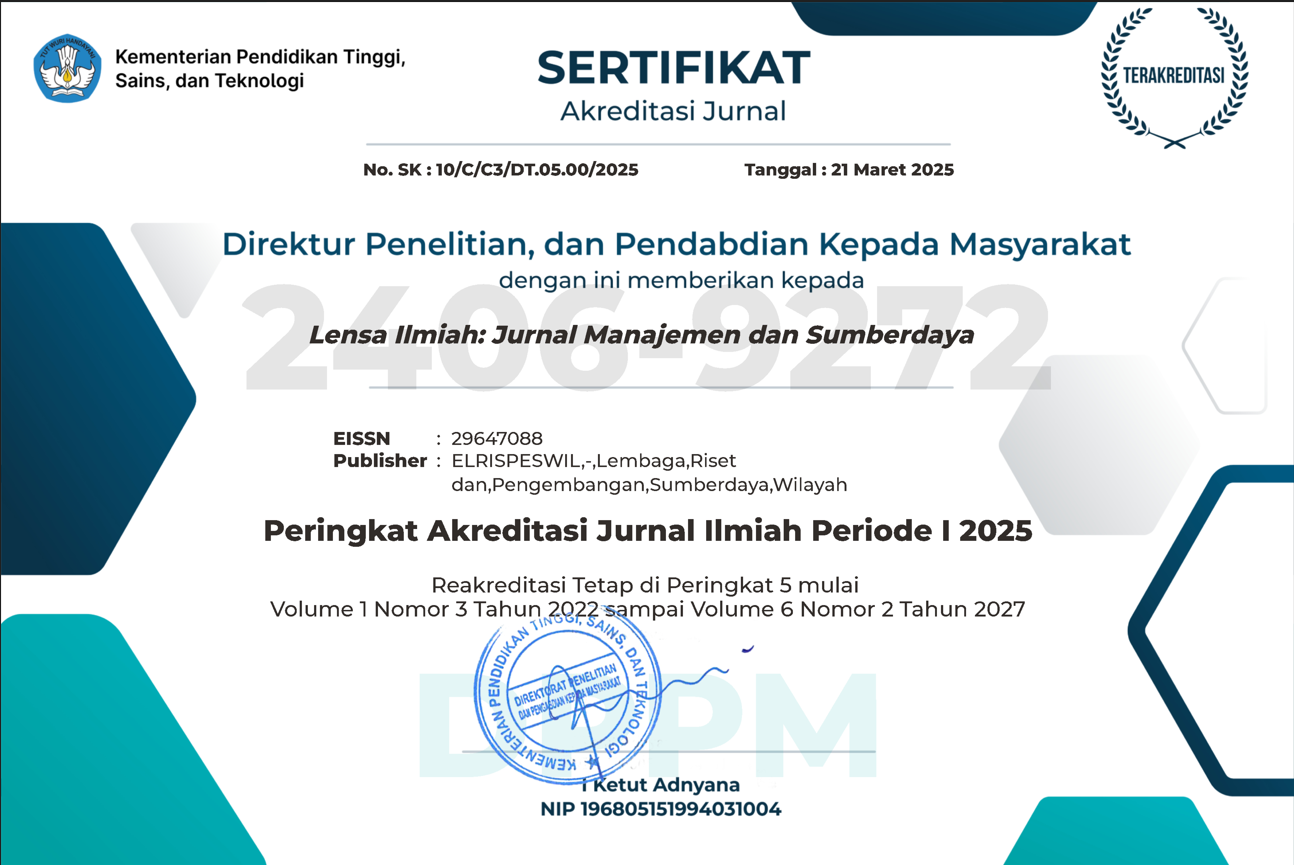
Lensa Ilmiah: Jurnal Manajemen dan Sumberdaya
(Scientific Lens: Journal of Management and Resources)
1. Purpose
Lensa Ilmiah: Jurnal Manajemen dan Sumberdaya (Scientific Lens: Journal of Management and Resources) is committed to maintaining the originality and integrity of all published scholarly work. The journal does not tolerate plagiarism or inappropriate reuse of previously published material.This policy specifically governs the screening, identification, classification, and editorial handling of plagiarism and inappropriate textual overlap. Broader allegations of research misconduct and post-publication actions are governed by the journal's Research Integrity and Post-Publication Policy.
2. Definition of Plagiarism
Plagiarism is the use of another person's words, ideas, data, methods, results, figures, tables, images, or other intellectual contributions without appropriate acknowledgment, attribution, or citation. Plagiarism may include:
- copying text from another source without appropriate quotation or citation;
- paraphrasing another person's work without proper acknowledgment;
- presenting another person's ideas, data, findings, or other intellectual contributions as one's own;
- translating material from another language without acknowledging the original source; and
- reusing previously published material in a manner that misleadingly represents it as original work.
Inappropriate reuse of an author's own previously published material may constitute inappropriate text recycling or redundant publication when it is not appropriately disclosed or cited.
3. Plagiarism and Similarity Screening
Submitted manuscripts are screened using Turnitin Software as a similarity-checking tool as part of the journal's editorial assessment. Screening is conducted during the initial editorial evaluation and may be repeated at subsequent stages when necessary.
The similarity report generated by Turnitin is evaluated by the editorial team. The journal does not determine plagiarism solely on the basis of an overall similarity percentage. Editors consider the source, extent, context, attribution, and nature of the identified overlap. Properly quoted and cited material, references, commonly used terminology, methodological expressions, and other legitimate similarities are considered when interpreting similarity reports. Therefore, a similarity score alone does not automatically determine whether a manuscript is accepted, revised, or rejected.
4. Identification and Classification
Potential plagiarism or inappropriate overlap is evaluated according to its nature, extent, context, attribution, and effect on the originality and integrity of the manuscript. For editorial assessment, concerns may generally be classified as follows:
4.1 Minor Overlap
Minor overlap may involve limited textual similarity, inadequate paraphrasing, incomplete attribution, or other localized problems that do not substantially compromise the originality or integrity of the manuscript.
4.2 Substantial Overlap
Substantial overlap may involve extensive unattributed text, significant inappropriate reuse of previously published material, or the use of another person's ideas, data, results, figures, tables, or other intellectual contributions without adequate acknowledgment.
4.3 Severe Plagiarism
Severe plagiarism may involve extensive or systematic copying, deliberate misrepresentation of another person's work as the author's own, unauthorized appropriation of data or results, or other forms of plagiarism that seriously compromise the originality and integrity of the manuscript. Classification is not determined solely by a numerical similarity threshold. Editorial judgment is based on the available evidence and the circumstances of each case.
5. Editorial Handling
When plagiarism or inappropriate overlap is identified in a submitted manuscript, the editorial team may:
- request clarification from the author(s);
- require correction of citations, attribution, quotation, or paraphrasing;
- request revision of the affected sections;
- reject the manuscript where the identified problem materially compromises its originality or integrity; or
- refer serious or broader integrity concerns for further assessment under the journal's Research Integrity and Post-Publication Policy.
Editorial action will be proportionate to the nature and seriousness of the identified problem. Authors will normally be given an appropriate opportunity to respond to significant concerns before a final determination is made.
6. Plagiarism Identified After Publication
When potential plagiarism is identified after publication, the journal will assess the concern in accordance with its Research Integrity and Post-Publication Policy. Where warranted, appropriate measures may include correction, Expression of Concern, retraction, or other actions necessary to maintain the integrity of the scholarly record. Detailed procedures for these actions are provided in the Research Integrity and Post-Publication Policy.
7. Relationship with Other Journal Policies
This Plagiarism Policy should be read together with the journal's Publication Ethics and Research Integrity and Post-Publication Policy.
The Publication Ethics policy establishes the ethical responsibilities of authors, reviewers, editors, and the publisher, while the Research Integrity and Post-Publication Policy governs the investigation and resolution of broader research-integrity concerns and post-publication cases. Where appropriate, the journal may refer to relevant guidance and good practices of the Committee on Publication Ethics (COPE) in evaluating and responding to plagiarism and related publication-integrity concerns.
8. Contact Information
Questions or concerns regarding plagiarism or inappropriate textual overlap may be directed to:
Lensa Ilmiah: Jurnal Manajemen dan Sumberdaya
E-ISSN: 2964-7088
Journal Email: lensailmiah.elr@gmail.com
For serious institutional concerns or matters requiring escalation beyond the editorial team:
Publisher: ELRISPESWIL – Lembaga Riset dan Pengembangan Sumberdaya Wilayah (Regional Resources Research and Development Institute)
Publisher Email: elr.ntb@gmail.com
Detailed allegations concerning published articles should be submitted and handled in accordance with the journal's Research Integrity and Post-Publication Policy.
Last Updated: October 2026
 JOURNAL & SUBMISSION
 Manuscript Submission
 Author Guidelines
 Aims and Scope
 Peer-Review Process
 Publication Frequency
 Publication Fee
 Editorial Board
 Reviewer List
 Abstract and Indexing
 Ownership & Management
 Plagiarism Policy
 Copyright and License
 Open Access statement
 Archiving Policy