Sertifikat Akreditasi 2025-2027
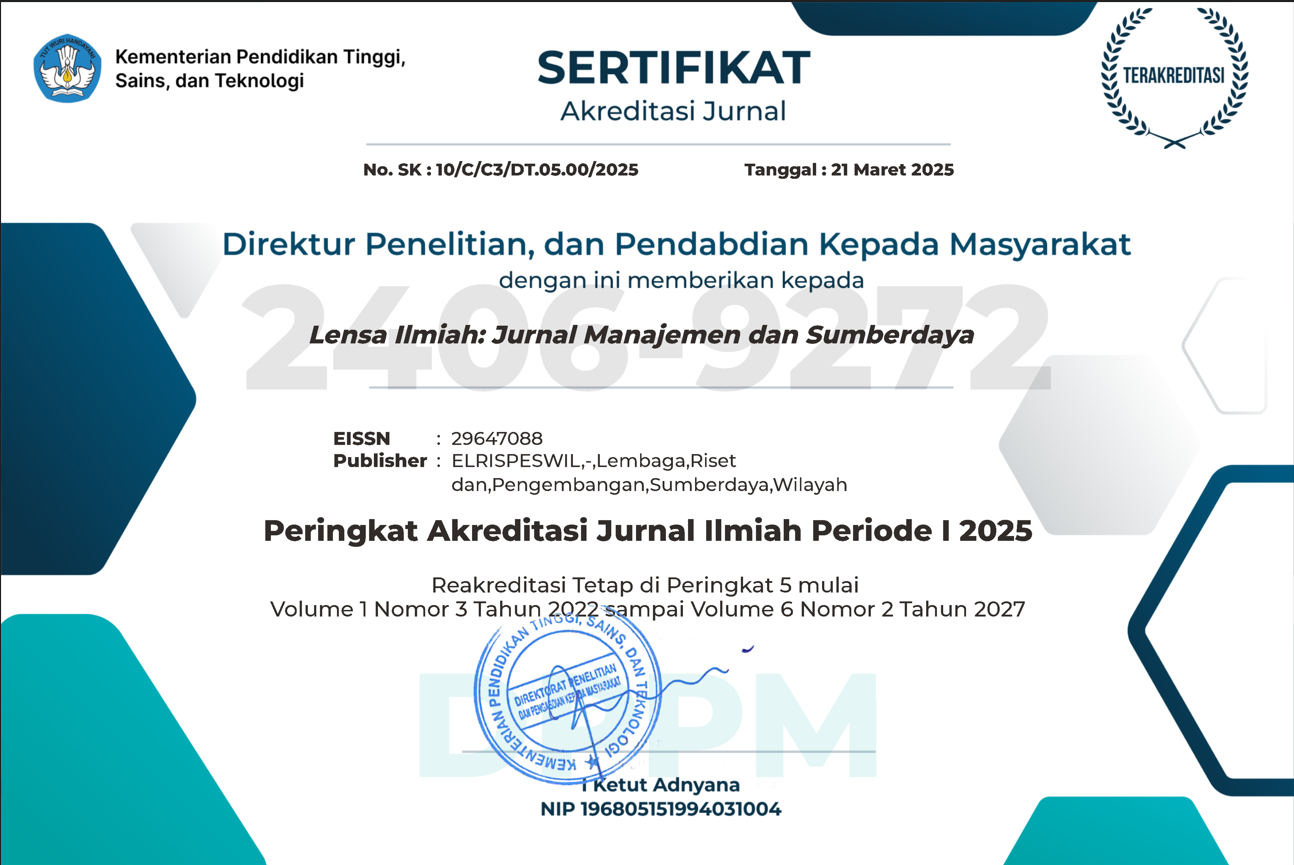

Lensa Ilmiah: Jurnal Manajemen dan Sumberdaya
1. Purpose and Scope
Lensa Ilmiah: Jurnal Manajemen dan Sumberdaya is committed to protecting the accuracy, reliability, transparency, and integrity of the scholarly record.
This policy establishes the procedures used by the journal to address concerns regarding research and publication integrity, particularly allegations of misconduct and issues identified during the editorial process or after publication. This policy covers:
The ethical responsibilities of authors, reviewers, editors, and the publisher are addressed separately in the journal's Publication Ethics policy.
2. Allegations of Research Misconduct
Lensa Ilmiah takes credible allegations of research and publication misconduct seriously, whether concerns are raised before or after publication. Research or publication misconduct may include, but is not limited to:
The existence of an allegation does not by itself establish that misconduct has occurred. The journal will assess concerns on the basis of available information and evidence.
3. Reporting Research Integrity Concerns
Concerns regarding a submitted manuscript or published article may be reported by authors, reviewers, readers, editors, institutions, or other parties. Reports should, whenever possible:
Reports should be submitted to: Lensa Ilmiah Editorial Office: Email: lensailmiah.elr@gmail.com
Where a concern involves the Editor-in-Chief, the journal's editorial management, a serious institutional issue, or a matter that cannot reasonably be handled by the editorial team, the concern may be escalated to:
Publisher: Lembaga Penelitian dan Pengembangan Sumberdaya Daerah
Email: elr.ntb@gmail.com
Anonymous reports may be considered when they contain sufficient and verifiable information to permit meaningful assessment. The journal is not obliged to pursue unsupported or clearly speculative allegations.
4. Initial Assessment
Upon receiving an allegation or research-integrity concern, the Editor-in-Chief or a designated editor will conduct an initial assessment. The initial assessment may consider:
Where an allegation is clearly unsupported, unrelated to the scholarly record, or outside the journal's responsibility, the journal may determine that no further action is required. Where sufficient grounds exist, the matter will proceed to clarification or further investigation.
5. Investigation and Clarification
When further examination is warranted, the journal may request information or clarification from the author(s) and other relevant parties. Depending on the nature of the concern, the journal may:
Authors are expected to cooperate with reasonable requests for clarification and supporting documentation.
The journal does not normally undertake institutional investigations into matters that require access to evidence or authority beyond the journal's reasonable capacity. Where appropriate, such matters may be referred to the authors' institution, research ethics committee, funding organization, or another competent authority.
6. Possible Editorial Actions
The outcome of an integrity assessment will depend on the available evidence, the seriousness of the issue, and its effect on the manuscript or scholarly record. Possible actions may include:
Editorial action is intended primarily to protect the reliability and integrity of scholarly communication rather than to punish individuals.
7. Post-Publication Discussion
Lensa Ilmiah recognizes that scholarly evaluation does not end when an article is published. Readers and members of the scholarly community may raise substantive questions, comments, criticisms, or concerns regarding published articles.
Post-publication discussion should relate to scientific, methodological, ethical, analytical, or other scholarly aspects of the published work and should be supported by reasonable argument or evidence. Post-publication comments and concerns may be submitted to: Email: lensailmiah.elr@gmail.com
Correspondence should clearly identify the article concerned, preferably including the article title, author(s), year of publication, DOI or article URL, and a clear explanation of the matter being raised.
7.1 Editorial Handling of Post-Publication Concerns
When a substantive concern is received, the editorial team may:
The journal may decline to process correspondence that is abusive, defamatory, discriminatory, unrelated to the scholarly content of the article, repetitive without new evidence, or unsupported by a reasonable basis.
Where post-publication discussion identifies a material issue affecting the accuracy or integrity of the scholarly record, the journal will consider the appropriate corrective action.
8. Corrections
A correction may be issued when an error or omission affects part of a published article but does not invalidate the article's principal findings or conclusions. Examples may include:
Where a correction is required, the journal will normally publish a correction notice that clearly identifies the original article and explains the nature of the correction.
Where technically appropriate, the published article may also be updated. Any substantive modification should be made transparently so that readers can determine that a correction has occurred.
Minor typographical or formatting errors that do not affect the meaning, interpretation, or scholarly record may be corrected without a separate formal correction notice where appropriate.
9. Expression of Concern
Lensa Ilmiah may publish an Expression of Concern when serious questions have been raised regarding a published article but sufficient evidence is not yet available to determine whether correction or retraction is warranted. An Expression of Concern may be appropriate when:
The Expression of Concern should be linked to the relevant article and should explain the basis of the concern to the extent reasonably possible.
When sufficient information becomes available, the journal may remove or supersede the Expression of Concern through an appropriate subsequent action, including a correction, retraction, or notice that no further action is required.
10. Retractions
Retraction may be considered when reliable evidence indicates that a published article should no longer be regarded as a reliable part of the scholarly record. Grounds for retraction may include, but are not limited to:
10.1 Retraction Notice
When an article is retracted, the journal will normally:
The retraction notice should be sufficiently clear to allow readers to understand why the article has been retracted while avoiding unnecessary defamatory or speculative statements.
Retraction is intended to correct the scholarly record and alert readers that the findings or content of an article should not be relied upon. It is not primarily intended as a sanction against the author(s).
11. Article Withdrawal
Article withdrawal generally applies to manuscripts that have been submitted or accepted but have not yet been formally published as part of an issue. Authors requesting withdrawal must communicate the request to the editorial office and provide a clear reason. Withdrawal requests: lensailmiah.elr@gmail.com
The journal will consider the request in light of the manuscript's editorial status and the circumstances surrounding the withdrawal. The journal may also withdraw an unpublished manuscript where serious concerns arise regarding:
Once an article has been formally published, removal from the scholarly record will be exceptional. Concerns affecting a published article will normally be addressed through correction, Expression of Concern, or retraction rather than deletion.
12. Removal of Published Content
Complete removal of published content will be considered only in exceptional circumstances, particularly where continued availability creates serious legal, privacy, confidentiality, or safety concerns that cannot reasonably be addressed through correction or retraction alone.
Where content must be removed, the journal should, where legally and technically possible, retain an appropriate bibliographic notice explaining that the content has been removed and the general reason for removal. Removal should not be used merely to conceal errors, misconduct, or an unfavorable publication history.
13. Complaints and Appeals
Authors, reviewers, readers, and other relevant parties may submit complaints concerning editorial procedures, publication-integrity matters, or the handling of submitted or published work.
Authors may also appeal an editorial decision when they believe that a significant factual, procedural, or evaluative error affected the decision. Complaints and appeals should:
Complaints and appeals should initially be submitted to:
Lensa Ilmiah Editorial Office
Email: lensailmiah.elr@gmail.com
Where a complaint concerns the Editor-in-Chief, journal management, or cannot reasonably be resolved at the editorial level, it may be escalated to:
Publisher: Lembaga Penelitian dan Pengembangan Sumberdaya Daerah
Email: elr.ntb@gmail.com
Where reasonably possible, an appeal or complaint should be considered by an editor or responsible party who was not directly involved in the matter being challenged.
An appeal does not automatically result in reversal of an editorial decision. A decision may be reconsidered where new evidence, a significant factual error, or a material procedural issue justifies further evaluation.
14. Confidentiality and Fair Process
The journal will handle allegations, investigations, complaints, appeals, and related communications with appropriate confidentiality. Information should normally be disclosed only to individuals or institutions whose involvement is reasonably necessary to assess or resolve the matter. The journal will seek to:
The identity of individuals raising concerns will be protected to the extent reasonably possible, subject to legal requirements and the practical needs of a fair investigation.
15. Institutional and External Investigations
The journal recognizes that universities, research institutions, ethics committees, funding organizations, and other competent bodies may have greater authority and capacity to investigate certain allegations of research misconduct.
Where appropriate, Lensa Ilmiah may refer a matter to the relevant institution or authority and may request information concerning the outcome of an investigation.
The journal retains responsibility for determining the appropriate editorial response concerning manuscripts and articles under its publication responsibility.
Where an external investigation is ongoing, the journal may take interim action, including suspension of editorial processing or publication of an Expression of Concern, when necessary to protect the scholarly record.
16. Relationship with Publication Ethics and Other Journal Policies
This policy should be read together with the journal's Publication Ethics and other applicable editorial policies.
The Publication Ethics policy establishes the ethical duties and responsibilities of authors, reviewers, editors, and the publisher.
This Research Integrity and Post-Publication Policy establishes the procedures for responding when concerns arise regarding the reliability, ethics, or integrity of submitted or published work.
Where a concern involves plagiarism, conflicts of interest, authorship, peer review, copyright, licensing, artificial intelligence, research ethics, or other matters governed by a specific journal policy, the relevant policies may be applied together.
17. Ethical Framework
Lensa Ilmiah handles research-integrity and post-publication matters with reference to internationally recognized principles and good practices in scholarly publishing, including relevant guidance provided by the Committee on Publication Ethics (COPE).
The journal seeks to ensure that corrective actions are transparent, proportionate, consistent, and focused on maintaining the integrity of the scholarly record.
Where a particular situation is not expressly covered by this policy, the editorial team may refer to relevant internationally recognized publication-ethics guidance in determining an appropriate course of action.
18. Contact Information
Reports of suspected research misconduct, concerns regarding published articles, requests for correction, post-publication comments, complaints, and appeals should normally be submitted to:
Lensa Ilmiah: Jurnal Manajemen dan Sumberdaya
E-ISSN: 2964-7088
Journal Email: lensailmiah.elr@gmail.com
For serious institutional concerns, matters involving the journal's editorial management, or issues requiring escalation beyond the editorial team:
Publisher: Lembaga Penelitian dan Pengembangan Sumberdaya Daerah
Publisher Email: elr.ntb@gmail.com
When contacting the journal regarding a specific manuscript or article, correspondents should provide sufficient identifying information and supporting evidence to enable the editorial team to assess the matter appropriately.
Last Updated: March 2026
Sertifikat Akreditasi 2025-2027
Template & Submissions:


Supported:


Lensa Ilmiah: Jurnal Manajemen dan Sumberdaya (Journal: Scientific Lens: Journal of Management and Resources)
ELRISPESWIL - Lembaga Riset dan Pengembangan Sumberdaya Wilayah- (ELRISPESWIL - Regional Resources Research and Development Institute)
 This work is licensed under a Creative Commons Attribution-ShareAlike 4.0 International License.
 The journal provides immediate open access to all articles on the principle that making research freely available to the public; supports a greater global exchange of knowledge; and is an invaluable way to maximize research's visibility and impact, especially in the education field.

 JOURNAL & SUBMISSION
  Manuscript Submission
 Author Guidelines
  Aims and Scope
 Peer-Review Process
 Publication Frequency
 Publication Fee
 Editorial Board
 Reviewer List
 Abstract and Indexing
 Publication Ethics
  Plagiarism Policy
  Copyright and License
  Open Access statement
 Archiving Policy