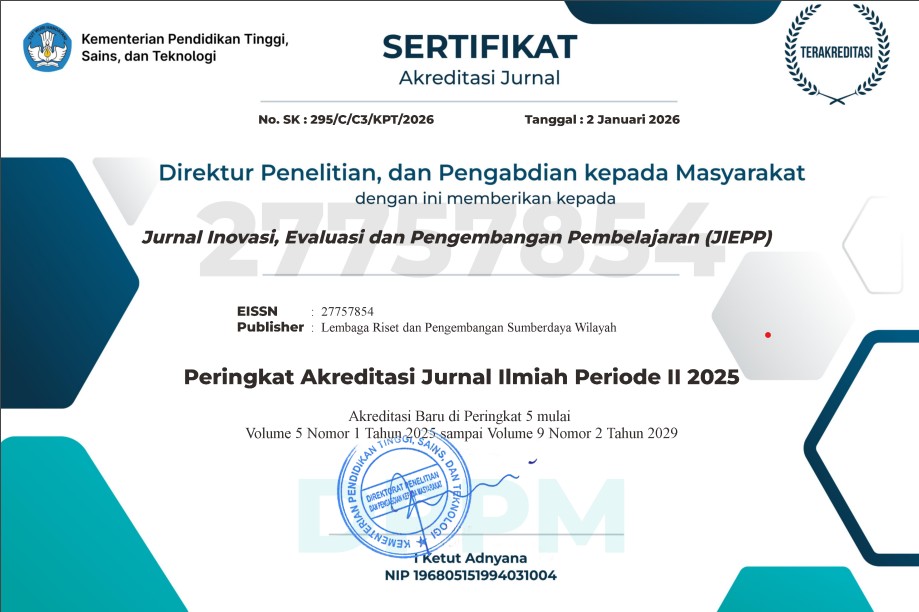
Sertifikat Akreditasi:

Journal of Innovation, Evaluation and Development of Learning (JIEPP) is a peer-reviewed academic journal that publishes original and scholarly works addressing the innovation, evaluation, design, development, implementation, and improvement of learning and educational practices across different levels and contexts of education.
JIEPP aims to provide a scholarly platform for researchers, academics, teachers, educational practitioners, and policymakers to disseminate empirical studies, theoretical and conceptual analyses, development studies, and evidence-based practices that contribute to improving the quality, effectiveness, accessibility, and sustainability of teaching, learning, assessment, and educational systems.
The journal particularly welcomes studies that demonstrate a clear educational problem, appropriate theoretical or conceptual grounding, methodological rigor, and a meaningful contribution to the development or improvement of educational practice and knowledge. The use of a particular technology, model, method, or educational program alone is not sufficient; manuscripts should clearly demonstrate their relevance and contribution to learning, instruction, assessment, curriculum, educational management, or educational development.
JIEPP covers, but is not limited to, the following areas:
Research on the design, implementation, adaptation, and evaluation of innovative teaching and learning strategies, models, methods, and approaches aimed at improving learning processes and outcomes.
Studies examining the pedagogical design, development, implementation, and evaluation of educational technologies, digital media, learning platforms, virtual environments, and technology-supported learning.
Research investigating the responsible and pedagogically grounded application of artificial intelligence, generative AI, intelligent tutoring systems, adaptive learning, learning analytics, and AI-supported tools for teaching, learning, feedback, and educational assessment.
Studies in this area should emphasize educational and pedagogical contributions, rather than focusing solely on the technical performance or development of AI systems.
Research addressing curriculum design, implementation, development, alignment, evaluation, and reform, including studies examining curriculum relevance, learning outcomes, competency frameworks, and curriculum responsiveness to educational and societal needs.
Studies related to educational leadership, institutional management, quality assurance, educational governance, policy implementation and evaluation, school or higher education management, and evidence-based decision-making that directly contributes to improving educational processes and outcomes.
Research on assessment and evaluation of learning processes and outcomes, including formative and summative assessment, diagnostic assessment, authentic assessment, competency assessment, assessment instruments, measurement models, feedback practices, and technology-enhanced assessment.
Studies concerning the systematic analysis, design, development, implementation, and evaluation of instructional systems, learning environments, instructional materials, learning media, modules, and other educational resources based on established instructional design principles and theories.
Classroom Action Research (CAR) addressing authentic educational problems through systematic cycles of planning, action, observation, reflection, and improvement.
CAR manuscripts should provide evidence of systematic improvement, reflective practice, and educational contribution, rather than merely reporting routine classroom interventions.
Research examining the implementation, evaluation, impact, challenges, and development of Merdeka Belajar policies and programs across educational levels, including curriculum flexibility, student-centered learning, experiential learning, institutional transformation, and other related educational initiatives.
Original empirical, theoretical, or development-oriented research addressing significant educational issues and contributing to the advancement of educational knowledge, policy, or practice.
Studies submitted under this scope must demonstrate a clear connection to learning, teaching, assessment, curriculum, educational technology, educational management, or educational development. Research situated in an educational setting but lacking a substantive educational contribution is outside the journal's scope.
Research on the design, implementation, interaction, engagement, accessibility, effectiveness, and evaluation of online, blended, hybrid, mobile, and digitally mediated learning environments, including learning management systems, virtual classrooms, and emerging digital learning ecosystems.
JIEPP welcomes high-quality manuscripts employing quantitative, qualitative, mixed-methods, research and development (R&D), design-based research, classroom action research, systematic reviews, meta-analyses, and other rigorous research approaches relevant to the journal's aims and scope.
Conceptual and theoretical manuscripts may also be considered when they provide a substantial contribution to the advancement of educational theory, policy, research, or practice.
To maintain the journal's scholarly focus, JIEPP generally does not consider manuscripts that:
Through this scope, JIEPP seeks to advance scholarly discussion and evidence-based practices concerning how learning is designed, implemented, evaluated, improved, and transformed in response to contemporary educational needs and emerging developments.
Sertifikat Akreditasi:
Template & Submissions:


Support & Indexing:



Software:


Supported:


Journal of Innovation, Evaluation and Development of Learning or Jurnal Inovasi, Evaluasi dan Pengembangan Pembelajaran (JIEPP) (E-ISSN: 2775-7854)
ELRISPESWIL - Regional Resources Research and Development Institute. (ELRISPESWIL - Lembaga Riset dan Pengembangan Sumberdaya Wilayah).
 This work is licensed under a Creative Commons Attribution-ShareAlike 4.0 International License.
 The journal provides immediate open access to all articles on the principle that making research freely available to the public; supports a greater global exchange of knowledge; and is an invaluable way to maximize research's visibility and impact, especially in the education field.

 MAIN MENU
  Manuscript Submission
 Author Guidelines
  Copyright and License
  Publication Ethics
  Plagiarism Policy
  Peer-Review Process
 Aims and Scope
 Open Access statement
 Archiving Policy
 Publication Fee
 Publication Frequency
 Editorial Board
 Reviewer List
 Contact