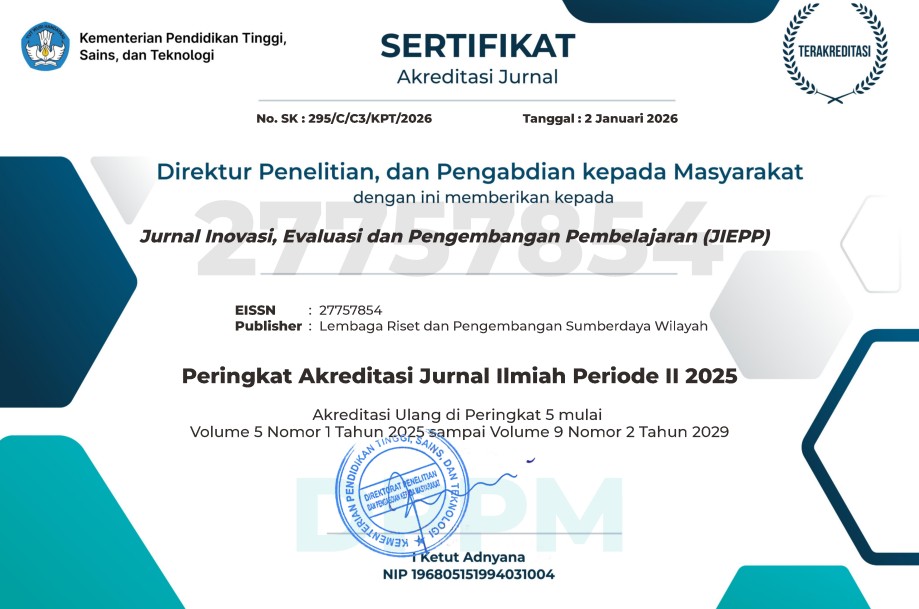
Sertifikat Akreditasi:

Journal of Innovation, Evaluation and Development of Learning (JIEPP) applies a rigorous and transparent peer-review process to ensure the quality, validity, originality, and relevance of all manuscripts considered for publication. The journal employs a double-blind peer review system, in which the identities of both authors and reviewers are concealed from each other throughout the review process.
The editorial and peer-review process consists of the following stages:

Authors submit their manuscripts through the JIEPP Online Journal System (OJS). Authors are responsible for ensuring that the manuscript complies with the journal's author guidelines, template, publication ethics, and submission requirements.
The editorial team conducts an initial administrative examination to ensure the completeness of the submission, including manuscript format, required metadata, authorship information, supporting documents, references, and compliance with the journal template and technical requirements.
Manuscripts that do not meet the basic submission requirements may be returned to the authors for technical correction before proceeding to editorial assessment.
The Editor conducts an initial assessment to determine whether the manuscript is suitable for further consideration.
The screening includes an assessment of:
At this stage, the Editor also conducts a preliminary assessment of the manuscript's internal and external validity, where relevant to the research design. This assessment considers whether the research design, sampling or participant selection, instruments, data collection procedures, analytical methods, and interpretation of findings provide a reasonable basis for the claims made by the authors and the extent to which those claims are appropriately bounded by the study context.
This preliminary assessment does not replace the detailed methodological evaluation conducted by peer reviewers.
Manuscripts with fundamental problems concerning scope, originality, scientific validity, methodological appropriateness, ethical compliance, or scholarly contribution may be rejected at the initial editorial screening stage without external peer review (desk rejection).
Manuscripts considered suitable after initial editorial screening are examined for originality and potential research-integrity concerns.
The editorial team may conduct similarity checking and examine indications of plagiarism, inappropriate citation practices, data or image manipulation, fabricated references, duplicate or redundant publication, undisclosed use of Generative AI, and other potential violations of publication ethics.
Similarity scores are not used as the sole basis for editorial decisions. The Editor evaluates the nature, location, and significance of identified similarities before determining whether further clarification or editorial action is required.
Manuscripts that pass the initial screening are assigned to at least two independent reviewers with expertise relevant to the manuscript's subject area and methodology.
Reviewer selection considers subject expertise, methodological competence, independence, absence of conflicts of interest, and the ability to provide an objective and constructive scholarly assessment.
JIEPP applies a double-blind peer review process. Authors' identities are concealed from reviewers, and reviewers' identities are not disclosed to authors.
Reviewers evaluate the manuscript critically and independently, particularly in relation to:
Reviewers are expected to provide constructive, evidence-based comments that assist both the Editor in making an editorial decision and the authors in improving the scholarly quality of their manuscripts.
Based on their assessment, reviewers may recommend one of the following:
Reviewer recommendations constitute an important component of the editorial process but do not constitute the final publication decision.
The Editor evaluates the reviewers' reports together with the manuscript's overall scholarly quality, methodological rigor, ethical compliance, and relevance to JIEPP.
The final decision may be:
Where reviewers provide substantially conflicting recommendations, the Editor may conduct an additional assessment, consult another member of the Editorial Board, or appoint an additional reviewer before making a decision.
The Editor-in-Chief and/or responsible Editor retains final authority over editorial decisions.
When revision is requested, authors must respond carefully to the reviewers' and Editor's comments and submit:
Changes made to the manuscript should be clearly identifiable according to the journal's revision instructions.
Failure to provide an adequate response or to address substantial scientific concerns may result in further revision or rejection.
Revised manuscripts are evaluated to determine whether the authors have adequately addressed the concerns raised during review.
For minor revisions, the Editor may evaluate the revised manuscript directly.
For major revisions, the manuscript may be returned to the original reviewers or assigned to other qualified reviewers when further independent evaluation is necessary.
Submission of a revised manuscript does not guarantee acceptance.
Before acceptance, the Editor conducts a final evaluation to ensure that:
The Editor may request additional clarification or correction when unresolved issues remain.
Once a manuscript has successfully completed the editorial and peer-review process, the Editor issues the final acceptance decision.
The manuscript then proceeds to the production stage, which may include:
Authors are responsible for carefully reviewing the proof and reporting only necessary corrections before publication.
Throughout the editorial and peer-review process, JIEPP is committed to the principles of fairness, confidentiality, independence, transparency, research integrity, and scholarly accountability.
Editorial decisions are based on the manuscript's scientific quality, methodological rigor, originality, relevance to the journal's Aims & Scope, ethical compliance, and contribution to the field, regardless of the authors' nationality, institutional affiliation, gender, academic position, or other characteristics unrelated to scholarly merit.
Editors and reviewers must maintain the confidentiality of submitted manuscripts and disclose any potential conflicts of interest. Reviewers must not use unpublished information obtained through the peer-review process for personal or professional advantage.
The use of Generative AI by editors and reviewers is governed by the journal's Generative AI Policy, particularly with regard to confidentiality, human accountability, and the prohibition against delegating scientific judgment or editorial decisions to AI systems.
Review Model: Double-Blind Peer Review
Number of Reviewers: At least two independent reviewers
Editorial Screening: Mandatory before external peer review
Final Decision: Editor-in-Chief and/or responsible Editor
Review Criteria: Scientific quality, originality, methodological rigor, validity, ethical compliance, relevance, and contribution to the field
Sertifikat Akreditasi:
Template & Submissions:


Support & Indexing:



Software:


Supported:


Journal of Innovation, Evaluation and Development of Learning or Jurnal Inovasi, Evaluasi dan Pengembangan Pembelajaran (JIEPP) (E-ISSN: 2775-7854)
ELRISPESWIL - Regional Resources Research and Development Institute. (ELRISPESWIL - Lembaga Riset dan Pengembangan Sumberdaya Wilayah).
 This work is licensed under a Creative Commons Attribution-ShareAlike 4.0 International License.
 The journal provides immediate open access to all articles on the principle that making research freely available to the public; supports a greater global exchange of knowledge; and is an invaluable way to maximize research's visibility and impact, especially in the education field.

 MAIN MENU
  Manuscript Submission
 Author Guidelines
  Copyright and License
  Publication Ethics
  Plagiarism Policy
  Peer-Review Process
 Aims and Scope
 Open Access statement
 Archiving Policy
 Publication Fee
 Publication Frequency
 Editorial Board
 Reviewer List
 Contact