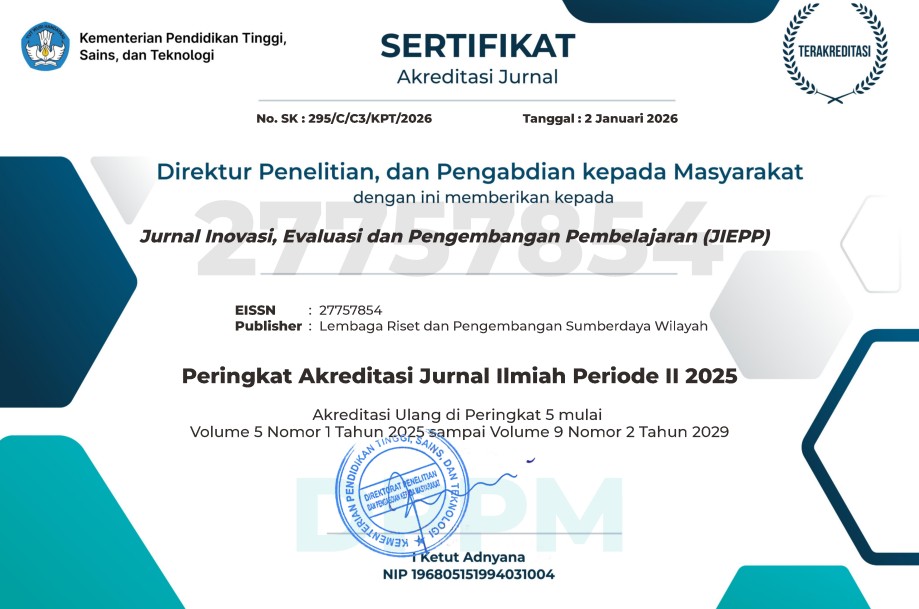
Sertifikat Akreditasi SINTA:

Authors are required to prepare manuscripts in accordance with the Ainara Journal template and the guidelines provided below. Manuscripts that do not follow the journal's scope, structure, formatting requirements, and publication ethics may be returned to the authors for revision before proceeding to the review process.
The manuscript should be organized as follows:
The methodological structure may be adapted to the type of manuscript, particularly for community service, development studies, systematic reviews, or other research designs requiring different methodological procedures.
Authors must use the latest article template available on the Ainara Journal website. The manuscript should comply with the formatting, typography, tables, figures, citation, and reference requirements specified in the template.
The title should be concise, specific, informative, and accurately represent the main focus of the manuscript. It should reflect the key concepts, variables, phenomena, or context investigated without unnecessary words or abbreviations. The title should contain a maximum of 15 words.
The abstract must be provided in English and Indonesian and written as a single concise paragraph. It should briefly present the research background or problem, objective, method, main findings, and conclusion or implications. The abstract should enable readers to understand the essential contribution of the study without referring to the main text.
A maximum of five keywords should be provided below the abstract. Keywords should represent the main concepts of the manuscript, be specific to the research topic, and support article indexing and discoverability.
The Introduction should establish the scientific context and rationale for the study. It should present the relevant background, empirical or theoretical problems, current state of research, research gap, novelty or contribution, and the objective(s) or research question(s).
Relevant and recent literature should be critically synthesized to demonstrate the position of the study within existing scholarship rather than merely presented as a sequence of previous studies. The Introduction should provide a clear justification for why the study is necessary.
The Methods section may be adapted to either Research Methods or Community Service Methods, depending on the type of manuscript. This section should provide sufficient information about the procedures and approaches employed in conducting the research or community service activities so that the process can be clearly understood and, where applicable, replicated.
The method should be presented clearly, systematically, and concisely without reporting the study findings. For research articles, the following methodological components should generally be addressed:
Present the research approach and specific design used, including its alignment with the research objectives or questions. Where relevant, identify the variables, groups, interventions, phenomena, or methodological framework employed.
Present the research setting and relevant characteristics of the participants, respondents, informants, population, or sample. Include the number of participants, sampling or participant-selection technique, and inclusion or exclusion criteria where applicable.
Describe the instruments or data-collection tools used, including the constructs or variables measured, indicators, measurement or scoring procedures, and sources of the instruments. Relevant evidence regarding validity, reliability, or other procedures used to ensure instrument quality should be reported where applicable.
Present the research and data-collection procedures systematically and chronologically, including the major stages, duration, and activities undertaken. For intervention studies, provide sufficient information regarding the treatment, implementation, duration, and frequency.
Specify the data-analysis techniques according to the research objectives, design, and characteristics of the data. Quantitative studies should report the relevant statistical procedures; qualitative studies should describe the analytical stages and procedures used to establish trustworthiness; mixed-methods studies should explain how quantitative and qualitative evidence was analyzed and integrated.
The Results section should present the main findings objectively and systematically according to the research objectives, questions, or hypotheses. Tables and figures may be used when they improve the clarity and efficiency of data presentation. Information presented in tables or figures should not be unnecessarily repeated in the text.
The Discussion should interpret and explain the significance of the findings rather than merely restating the results. Authors should relate the findings to relevant theories and previous studies, explain similarities or differences with existing evidence, discuss possible explanations, and demonstrate the scientific or practical contribution of the study.
The Conclusion should directly address the research objectives and summarize the principal meaning of the findings without simply repeating the Results and Discussion. Relevant implications, limitations, and recommendations for future research or practice may be included where appropriate. The conclusion should be presented concisely in paragraph form.
Authors must disclose any financial, professional, personal, or other relationships that could potentially influence the research or publication of the manuscript. If no conflict exists, authors should explicitly declare that there is no conflict of interest.
The contribution of each author should be clearly stated. Contributions may include conceptualization, methodology, investigation, data collection, data analysis, validation, writing—original draft, writing—review and editing, visualization, supervision, and project administration. All listed authors must have made a meaningful contribution to the manuscript and approved its final version.
Authors must disclose all sources of financial support for the research and/or publication, including the funding institution and grant or contract number where applicable. If the study received no external funding, this should be explicitly stated.
Authors may acknowledge individuals, institutions, organizations, or other parties who contributed to the research but do not meet the criteria for authorship. Acknowledgment should not be used to replace the declaration of research funding.
Authors must disclose the use of generative artificial intelligence (AI) or AI-assisted technologies in preparing the manuscript, including the tool used and its specific purpose where applicable. AI tools cannot be listed as authors and cannot replace the authors' responsibility for the originality, accuracy, integrity, and validity of the manuscript.
Authors remain fully responsible for reviewing and verifying any AI-assisted content included in the manuscript. If generative AI or AI-assisted technologies were not used, authors should explicitly state this in accordance with the journal template.
References should primarily consist of relevant, credible, and up-to-date scholarly sources that directly support the manuscript. Authors are encouraged to prioritize peer-reviewed journal articles and other authoritative academic sources.
References and in-text citations must follow the APA Style specified in the latest Ainara Journal template. Authors are strongly encouraged to use reference-management software such as Mendeley or Zotero to maintain citation and reference consistency.
Every source included in the reference list must be cited in the manuscript, and every source cited in the manuscript must appear in the reference list. Where available, the DOI should be provided accurately.
Authors should select references based on their scientific relevance and contribution to the manuscript. Citation of articles previously published in Ainara Journal is welcomed when scientifically relevant but is not mandatory and must not be included solely to meet a citation requirement.
**September 2026 Update.
Sertifikat Akreditasi SINTA:
Template & Submissions:


Support & Indexing:






Software:


Supported:



 MAIN MENU
 Manuscript Submission
 Author Guidelines
  Copyright and License
  Publication Ethics
  Plagiarism Policy
  Peer-Review Process
 Aims and Scope
 Open Access statement
 Archiving Policy
 Publication Fee
 Publication Frequency
 Editorial Board
 Reviewer List
 Contact