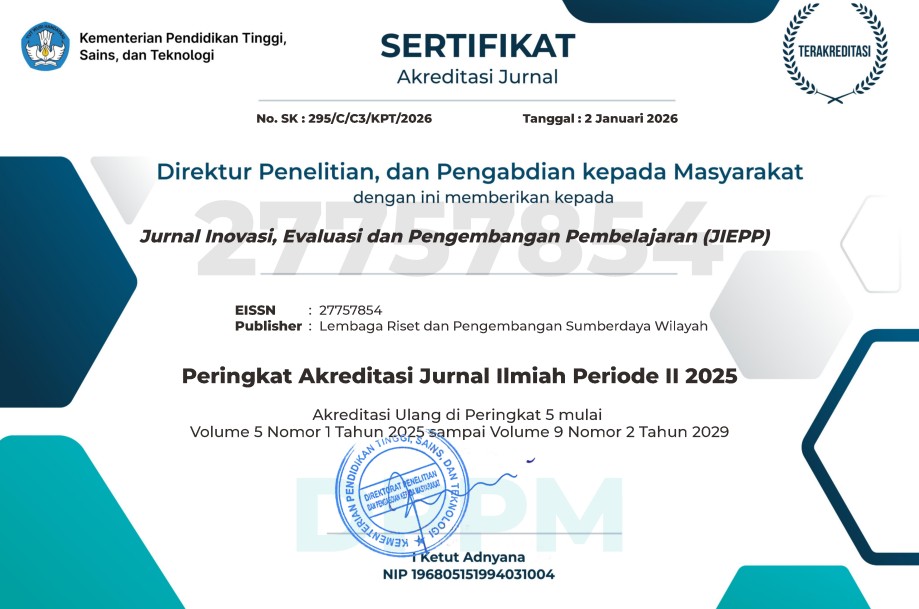
Sertifikat Akreditasi SINTA:

Ainara Journal (Jurnal Penelitian dan PKM Bidang Ilmu Pendidikan) applies a double-blind peer review process to ensure objective, independent, and confidential evaluation. The identities of authors and reviewers are concealed from each other throughout the review process. The editorial process involves authors, editors, section editors, and independent reviewers.

Authors are required to submit their manuscripts through the Ainara Journal OJS together with relevant supporting research files. Depending on the type and methodology of the study, supporting files may include datasets or raw research data, data analysis outputs generated using SPSS or other relevant software, plagiarism/similarity check reports, research instruments, ethical approval or research permission where applicable, and other documents necessary to support research transparency and verification.
For empirical quantitative studies, authors are particularly expected to provide the dataset or raw data and relevant analysis outputs used to produce the findings reported in the manuscript. For qualitative, mixed-methods, R&D, SLR, bibliometric, and other types of studies, supporting files should be adjusted to the characteristics and procedures of the research.
Supporting files are primarily used for editorial verification and peer-review purposes and are not automatically published as part of the article unless otherwise determined by the journal.
All submissions undergo an initial screening by the editorial team to verify compliance with the Ainara Journal template, manuscript completeness, availability and relevance of supporting files, similarity requirements, and publication ethics.
At this stage, the Editor also conducts a preliminary assessment of the study's internal and external validity. The assessment considers whether the research design, participant or sample selection, instruments, procedures, data collection, and analytical methods adequately support the conclusions reported in the manuscript. The Editor also considers whether the interpretation, applicability, transferability, or generalizability of the findings is appropriate to the research design, context, population, and stated limitations of the study.
The depth and criteria of validity assessment are adjusted to the methodological approach employed. Therefore, criteria applicable to experimental or quantitative studies are not applied mechanically to qualitative, mixed-methods, R&D, SLR, bibliometric, or other research designs.
The Editor may examine the submitted dataset or raw data, statistical or analytical outputs, research instruments, similarity report, and other supporting documents to verify consistency among the reported methods, analyses, results, and conclusions. Additional data or documents may be requested when necessary.
Manuscripts with incomplete requirements, substantial methodological weaknesses, inconsistencies between data and reported findings, or serious threats to research validity may be returned for clarification or correction or may not proceed to external peer review.
Manuscripts that pass the initial screening proceed to editorial evaluation. The Editor or Section Editor assesses the manuscript's alignment with the journal's Aims and Scope, scientific quality, research gap, novelty, methodological adequacy, relevance, and contribution to the field of education.
Manuscripts that do not demonstrate sufficient relevance, novelty, methodological quality, or scientific contribution may be rejected at this stage without external peer review (desk rejection).
Manuscripts that meet the editorial criteria are assigned to a minimum of two independent reviewers with expertise relevant to the manuscript. Neither authors nor reviewers are informed of each other's identities.
Reviewers assess the manuscript based on originality and novelty, theoretical foundation, methodological rigor, validity of the research, quality of data analysis and findings, depth of discussion, relevance of references, contribution to the field of education, and overall quality of scientific presentation.
Where necessary, supporting research files may be examined to assist in verifying the methods, analyses, and findings reported in the manuscript.
Based on their evaluation, reviewers may provide one of the following recommendations: Accept, Minor Revision, Major Revision, or Reject.
Reviewer recommendations constitute an important consideration in the editorial decision but do not independently determine the final decision. The final authority regarding manuscript acceptance or rejection remains with the Editor.
For manuscripts requiring revision, authors must revise the manuscript and provide an appropriate response to the reviewers' comments within the specified period.
Authors should clearly indicate the changes made and provide scientific justification when a reviewer recommendation cannot be accommodated. Authors may also be requested to submit additional data, analysis outputs, instruments, or other supporting documents when required to clarify or verify revisions.
The revised manuscript and authors' responses are evaluated by the Editor. When necessary, particularly following major revisions or when further scientific verification is required, the manuscript may be returned to the original reviewers or assigned for additional review.
The review and revision process may involve more than one round until the manuscript meets the scientific and editorial standards of Ainara Journal or is determined to be unsuitable for publication.
The final decision regarding acceptance or rejection is made by the Editor by considering the reviewers' recommendations, the quality and completeness of the authors' revisions, methodological and scientific validity, consistency between supporting data and reported findings, and compliance with Ainara Journal's editorial and publication standards.
A manuscript is considered officially accepted only after the Editor has issued an Accepted decision through the Ainara Journal OJS.
Authors whose manuscripts have officially obtained Accepted status in the Ainara Journal OJS may request a Letter of Acceptance (LoA).
The request must be submitted through the official email address of Ainara Journal by clearly stating the Manuscript ID. The Manuscript ID enables the editorial team to verify the manuscript and its official acceptance status in the journal system.
LoA requests will only be processed for manuscripts officially declared Accepted in the Ainara Journal OJS. A reviewer recommendation of Accept, completion of revisions, or other communication prior to the Editor's official acceptance decision does not constitute official acceptance.
Accepted manuscripts proceed to the copyediting stage to ensure linguistic, stylistic, structural, citation, reference, and journal-format consistency without altering the substantive meaning of the manuscript.
Authors may be contacted when clarification or confirmation is required during this process.
Following copyediting, the manuscript proceeds to layout and proofreading. The article is prepared according to the journal's publication format, and authors may be requested to review the final proof to identify typographical, formatting, or other production-related errors before publication.
After completing all editorial and production stages, the article is published in Ainara Journal (Jurnal Penelitian dan PKM Bidang Ilmu Pendidikan) according to the journal's publication schedule.
The duration of the editorial and peer-review process may vary depending on manuscript complexity, methodological verification requirements, reviewer availability, authors' responsiveness to revisions, and the number of review rounds required.
**September 2026 Update.
Sertifikat Akreditasi SINTA:
Template & Submissions:


Support & Indexing:





Software:


Supported:



 MAIN MENU
 Manuscript Submission
 Author Guidelines
  Copyright and License
  Publication Ethics
  Plagiarism Policy
  Peer-Review Process
 Aims and Scope
 Open Access statement
 Archiving Policy
 Publication Fee
 Publication Frequency
 Editorial Board
 Reviewer List
 Contact