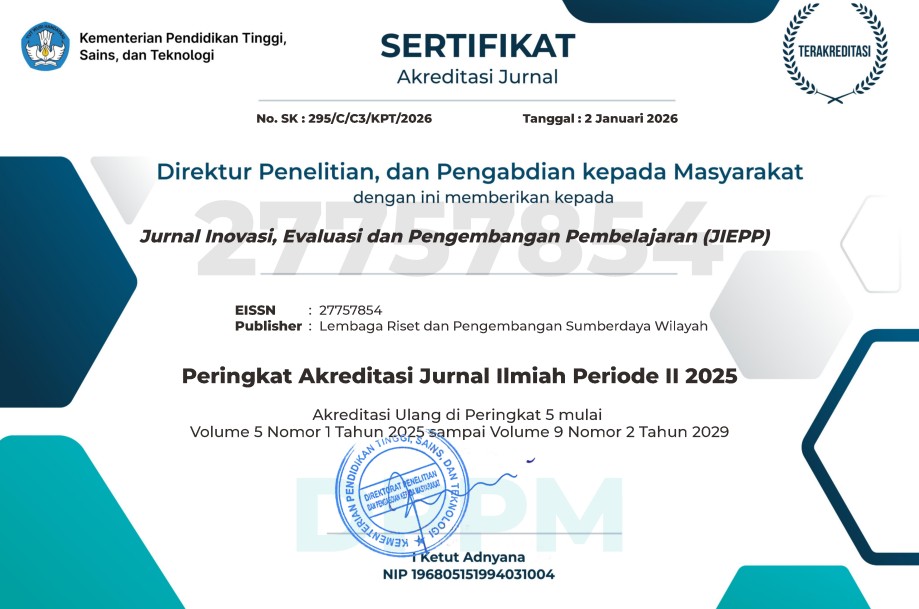
Sertifikat Akreditasi SINTA:

Ainara Journal (Jurnal Penelitian dan PKM Bidang Ilmu Pendidikan)
Ainara Journal recognizes that Artificial Intelligence (AI), including Generative Artificial Intelligence (Generative AI/GenAI), can support research, academic writing, editing, and scholarly publishing when used responsibly.
This policy applies to all parties involved in the publication process, including authors, editors, reviewers, and journal staff.
The use of AI must adhere to the principles of:
AI may serve only as a supporting tool and must not replace human critical thinking, scholarly expertise, scientific interpretation, or decision-making.
Generative AI refers to artificial intelligence technologies capable of generating or modifying content such as text, images, audio, code, synthetic data, or other forms of content based on user input.
These technologies include, but are not limited to, Large Language Models and generative AI services such as ChatGPT, Gemini, Claude, Microsoft Copilot, DALL·E, Midjourney, Stable Diffusion, and similar technologies.
AI-assisted technologies are AI-based tools used to support human activities, including language editing, translation, information organization, data analysis, programming, and other supporting tasks.
The use of such technologies does not reduce the user's responsibility to verify the accuracy and integrity of their outputs.
Ainara Journal does not recognize AI systems, Generative AI, Large Language Models, chatbots, or other AI-based technologies as authors or co-authors.
Authorship requires the ability to make intellectual contributions, approve the final manuscript, assume responsibility for the integrity and accuracy of the work, manage conflicts of interest, and respond to questions concerning the published work.
Because AI systems cannot fulfill these responsibilities, they must not be listed as authors or treated as entities accountable for scholarly work.
Full responsibility for the manuscript remains with the human authors.
Ainara Journal permits the responsible use of Generative AI and AI-assisted technologies as supporting tools, provided that they do not replace the authors' intellectual contributions or scholarly judgment.
AI may be used, subject to human review and verification, to support activities such as:
Authors must critically review and verify all AI-generated outputs before incorporating them into their manuscripts.
AI-generated information must not be treated as an authoritative scientific source. Facts, quotations, references, DOIs, analytical results, and other information must be verified against original and reliable sources.
Authors must disclose substantive use of Generative AI when it contributes materially to the manuscript or research process, including when AI is used to:
When AI forms part of the research methodology, its use must also be described adequately in the Methods section to support transparency and, where relevant, reproducibility.
Basic automated functions that perform only mechanical or technical corrections generally do not require an AI declaration, including:
However, when an AI system makes substantive changes to the content, argumentation, interpretation, structure, or organization of a manuscript, its use must be disclosed.
Ainara Journal prohibits the use of AI to:
The use of AI does not absolve authors from responsibility for errors, bias, fabricated information, false references, or ethical violations contained in their manuscripts.
Authors are fully responsible for verifying every reference obtained or recommended through AI systems.
Authors must verify the existence and accuracy of the source, authors, title, journal or publisher, publication details, DOI or URL, and whether the cited source genuinely supports the associated claim.
AI-generated or AI-recommended references must not be included in a manuscript without verification against the original publication source.
Fabricated or non-existent references may result in requests for clarification, research-integrity assessment, or rejection of the manuscript.
Generative AI must not be used to create or manipulate images that serve as research data or scientific evidence where such generation or modification could alter the interpretation of the research findings.
AI-assisted conceptual diagrams, illustrations, graphical abstracts, or other non-data visual materials may be considered only when their use:
Where AI has been used to generate or modify an image, the tool and nature of its use should be disclosed in the figure caption or AI declaration.
Editors may request original files, source data, or documentation concerning the production of visual materials when necessary.
When Generative AI has been used substantively in manuscript preparation, authors must include a separate section immediately before the References, entitled:
Recommended declaration:
During the preparation of this manuscript, the author(s) used [name and version of AI tool/service] for [describe the purpose]. Following the use of this tool/service, the author(s) reviewed, verified, and edited all outputs incorporated into the manuscript. All scientific analyses, interpretations, arguments, and conclusions remain the responsibility of the author(s). The author(s) take full responsibility for the accuracy, originality, and integrity of the published content.
Where AI has been used as part of the research process or data analysis, appropriate methodological details must additionally be provided in the Methods section.
Submitted manuscripts are confidential documents.
Reviewers must not upload a submitted manuscript or any part of it, including figures, tables, data, supplementary materials, or unpublished information, to public Generative AI services or AI systems that do not provide adequate confidentiality protections.
Reviewers must not delegate scientific assessment to AI.
AI must not replace human evaluation of:
Limited AI assistance may be used to improve the language or organization of a review report provided that no confidential manuscript information is disclosed and the reviewer retains full responsibility for the report.
Substantive AI assistance in preparing a review report must be disclosed to the editor.
Editors remain fully accountable for editorial evaluation and decision-making.
Editors must not upload unpublished manuscripts or any part thereof to public AI services or AI systems that do not provide adequate confidentiality protection.
AI must not independently determine:
AI may be used in limited administrative or technical supporting roles when manuscript confidentiality is maintained.
Final editorial decisions must always be made and assumed by human editors.
Authors, reviewers, and editors must carefully consider the privacy policies and terms of service of any AI technologies they use.
The following information must not be submitted to public AI systems or services without adequate confidentiality protection:
Users remain responsible for ensuring that their use of AI does not violate privacy, confidentiality, intellectual-property rights, or third-party rights.
Ainara Journal does not make editorial decisions solely on the basis of an AI-content detector, AI-generated percentage, or other automated detection score.
Where such tools are used, their outputs will be treated only as preliminary indicators and must be accompanied by human evaluation and other supporting evidence.
Editors may request clarification regarding authors' writing processes, data, sources, analytical methods, references, or AI use where reasonable concerns require further verification.
Suspected violations of this policy may be investigated in accordance with Ainara Journal's publication-ethics and research-integrity procedures.
The journal may:
Confirmed violations may result in manuscript rejection, termination of peer review, correction, expression of concern, article retraction, or other actions proportionate to the nature and severity of the violation and consistent with applicable publication-ethics guidelines.
The use of AI does not diminish authors' responsibility for manuscripts submitted to Ainara Journal.
By submitting a manuscript, all authors confirm that they:
AI may assist scholarly work, but scientific responsibility and accountability remain human.
AI technologies and standards for responsible scholarly publishing continue to evolve rapidly. Ainara Journal therefore reserves the right to periodically review and update this policy in response to developments in technology, regulation, publication ethics, and international scholarly-publishing standards.
This policy has been developed with reference to principles and guidance provided by the Committee on Publication Ethics (COPE), Elsevier, Springer Nature, Wiley, and internationally recognized practices concerning the responsible use of artificial intelligence in scholarly communication.
**September 2026 Update.
Sertifikat Akreditasi SINTA:
Template & Submissions:


Support & Indexing:





Software:


Supported:



 MAIN MENU
 Manuscript Submission
 Author Guidelines
  Copyright and License
  Publication Ethics
  Plagiarism Policy
  Peer-Review Process
 Aims and Scope
 Open Access statement
 Archiving Policy
 Publication Fee
 Publication Frequency
 Editorial Board
 Reviewer List
 Contact