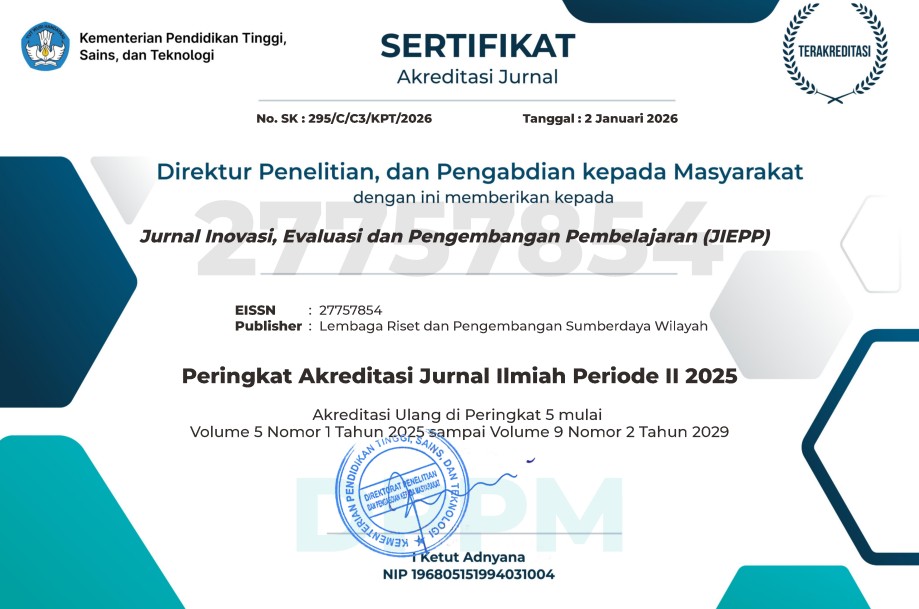
Sertifikat Akreditasi SINTA:

Ainara Journal (Jurnal Penelitian dan PKM Bidang Ilmu Pendidikan) is a peer-reviewed scientific journal that provides an academic platform for the publication and dissemination of high-quality research and community engagement in the field of education.
The journal aims to advance educational theory and practice by prioritizing empirical and evidence-based research, particularly quantitative studies that provide robust evidence regarding educational interventions, relationships, effects, and outcomes. Experimental, quasi-experimental, correlational, survey, development, and other rigorous quantitative research designs are particularly encouraged.
Qualitative research, mixed-methods studies, Systematic Literature Reviews (SLR), bibliometric studies, and other relevant approaches are also welcomed. Such manuscripts are expected to demonstrate a clearly articulated research gap, strong novelty, methodological rigor, and substantive contribution beyond merely describing phenomena, mapping publications, or summarizing existing literature.
In response to emerging developments in education, Ainara Journal particularly encourages research addressing Artificial Intelligence (AI)-based learning and emerging educational technologies, while continuing to accommodate broader innovations and contemporary issues in education.
Ainara Journal publishes original scholarly works in education, with particular emphasis on learning innovation, empirical educational research, AI-enhanced learning, and evidence-based educational practices. The journal's scope includes, but is not limited to:
Ainara Journal gives publication priority to empirical quantitative research, particularly studies employing experimental and quasi-experimental designs, as well as other rigorous quantitative approaches capable of providing robust evidence concerning educational interventions, relationships, differences, predictors, or outcomes.
Research and Development (R&D), mixed-methods research, and other empirical designs are also encouraged when they demonstrate methodological rigor and clear educational contributions.
Qualitative research, Systematic Literature Reviews (SLR), and bibliometric studies remain eligible for publication; however, these manuscripts are expected to demonstrate a strong and explicit research gap, clear novelty, rigorous methodology, analytical depth, and significant theoretical or practical contribution. Manuscripts that merely describe phenomena, summarize previous studies, or present descriptive bibliometric mappings without substantive interpretation and novelty may not be prioritized for publication.
Regardless of the methodology employed, manuscripts should demonstrate a clear contribution to the advancement of educational knowledge, policy, technology, or practice.
Manuscripts may be considered outside the scope of Ainara Journal when their primary focus does not demonstrate a clear and substantive connection to education, teaching and learning, educational technology, educational development, or community engagement in education.
Studies from other disciplines may be considered only when their research questions, theoretical foundations, methods, findings, and implications provide an explicit and meaningful contribution to educational knowledge or practice. Merely using students, teachers, schools, universities, or other educational institutions as research participants or settings does not automatically establish relevance to the journal's scope.
Sertifikat Akreditasi SINTA:
Template & Submissions:


Support & Indexing:





Software:


Supported:



 MAIN MENU
 Manuscript Submission
 Author Guidelines
  Copyright and License
  Publication Ethics
  Plagiarism Policy
  Peer-Review Process
 Aims and Scope
 Open Access statement
 Archiving Policy
 Publication Fee
 Publication Frequency
 Editorial Board
 Reviewer List
 Contact